


Quick Answer
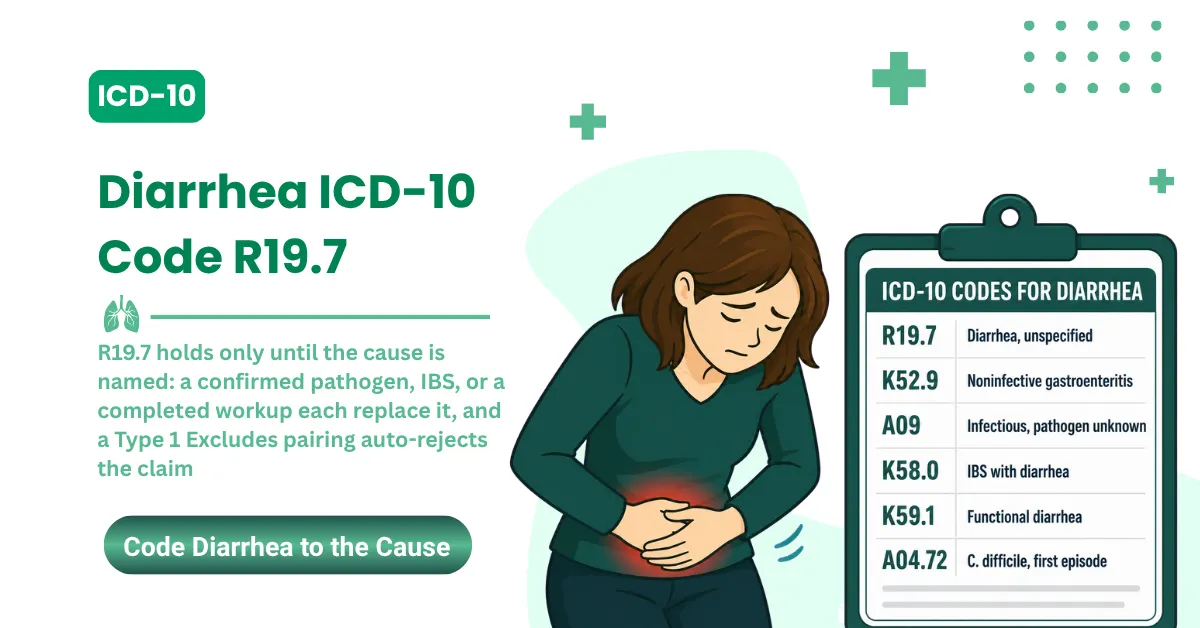
The primary ICD-10 code for diarrhea is R19.7, Diarrhea, unspecified. It's valid per FY 2026 ICD-10-CM, effective October 1, 2025 through September 30, 2026.
|
Code |
Official Descriptor |
Use When |
Do Not Use When |
DRG |
|---|---|---|---|---|
|
R19.7 |
Diarrhea, unspecified |
Cause unknown, no confirmed diagnosis, initial visit |
A specific diagnosis has been confirmed |
391/392 |
|
K52.9 |
Noninfective gastroenteritis and colitis, unspecified |
Chronic non-infectious diarrhea, origin not identified |
Infection present; K59.1 or R19.7 still applies |
391/392 |
|
A09 |
Infectious gastroenteritis and colitis, unspecified |
Infection suspected or confirmed, pathogen unknown |
Specific pathogen confirmed (use A04.X) |
391/392 |
|
K59.1 |
Functional diarrhea |
Chronic diarrhea, full workup complete, no organic cause |
IBS is present; workup not yet done |
391/392 |
|
A04.71/A04.72 |
C. difficile enterocolitis |
C. diff confirmed by toxin assay (71 recurrent; 72 first episode) |
Any of the above apply |
371/373 |
Source: ICD-10-CM Official Guidelines for Coding and Reporting, FY 2026, CMS/NCHS.
R19.7, Diarrhea, unspecified, is the primary ICD-10-CM code for diarrhea in the United States. It belongs to Chapter 18, Symptoms, Signs, and Abnormal Clinical and Laboratory Findings, and it applies when a patient presents with loose or watery stools but a provider hasn't confirmed a specific infectious or underlying cause.
For the diarrhea ICD-10 code to be coded correctly, providers and billers have to know which code from the R19.7, K52.9, A09, K58.0, and K59.1 family applies. Choosing the wrong one is among the most common denial triggers in gastroenterology and internal medicine billing.
The ICD-10-CM Official Guidelines FY 2026, jointly maintained by CMS and the National Center for Health Statistics (NCHS), govern all U.S. provider claims for dates of service from October 1, 2025 through September 30, 2026.
At MedSole RCM, our certified coding specialists handle diarrhea coding, gastroenterology claims, and ICD-10 compliance across 75+ specialties, so providers don't absorb avoidable denials from code-selection errors.
Practices that want that accuracy without building it in-house find our outsourced medical billing services to be the cleanest path to a 99% clean claim rate at 2.99% of collections.
FY2026 Quick Reference: All Diarrhea ICD-10 Codes
Every diarrhea ICD-10 billing decision starts with selecting the right code from the table below. The code selected determines DRG assignment, Excludes1 compliance, and whether your claim passes payer edits on the first submission.
|
Code |
Official Descriptor |
Chapter |
Use When |
Excludes1 With |
DRG |
FY2026 |
|---|---|---|---|---|---|---|
|
R19.7 |
Diarrhea, unspecified |
18 |
Cause unknown, no confirmed diagnosis |
K59.1, P78.3, F45.8 |
391/392 |
Active |
|
K52.9 |
Noninfective gastroenteritis and colitis, unspecified |
11 |
Chronic, non-infectious, specific dx not established |
R19.7, K59.1, A09, P78.3 |
391/392 |
Active |
|
A09 |
Infectious gastroenteritis and colitis, unspecified |
1 |
Infection suspected or confirmed, pathogen unidentified |
K52.9, R19.7 |
391/392 |
Active |
|
K58.0 |
IBS with diarrhea |
11 |
IBS confirmed, diarrhea predominant, Rome IV met |
K59.1, R19.7 |
391/392 |
Active |
|
K59.1 |
Functional diarrhea |
11 |
Full workup complete, no organic cause, no IBS |
R19.7, K58.0 |
391/392 |
Active |
|
K52.1 |
Toxic gastroenteritis and colitis |
11 |
Drug or medication-induced diarrhea |
Requires T-code |
393/395 |
Active |
|
A04.71 |
C. difficile, recurrent |
1 |
C. diff toxin positive, documented recurrence |
none |
371/373 |
Active |
|
A04.72 |
C. difficile, not specified as recurrent |
1 |
C. diff toxin positive, first episode |
none |
371/373 |
Active |
|
K52.2 |
Allergic and dietetic gastroenteritis |
11 |
Food allergy or intolerance confirmed |
none |
391/392 |
Active |
|
P78.3 |
Noninfective neonatal diarrhea |
16 |
Neonate under 28 days, noninfective cause |
R19.7 |
Varies |
Active |
|
F45.8 |
Other somatoform disorders |
5 |
Psychogenic diarrhea, physical causes ruled out |
none |
Varies |
Active |
|
Z87.19 |
Personal history of digestive disease |
21 |
Resolved or inactive diarrheal condition |
none |
none |
Active |
A04.71 and A04.72 (C. difficile) group to DRG 371-373, a materially different reimbursement tier than DRG 391-392. Documenting whether C. diff is recurrent (A04.71) or a first episode (A04.72) is a billing requirement, not a clinical detail.
R19.7: The Primary ICD-10 Code for Diarrhea
R19.7 ICD-10 Code Definition and Chapter 18 Classification
R19.7, Diarrhea, unspecified, is a billable ICD-10-CM diagnosis code in Chapter 18 of the Tabular List, Symptoms, Signs, and Abnormal Clinical and Laboratory Findings. The FY 2026 edition became effective October 1, 2025.
The code applies to loose or watery stools where a provider hasn't confirmed a specific infectious, functional, or organic cause. It covers what the Alphabetic Index lists as watery diarrhea presentations, including cases where stool cultures are pending and the clinical picture hasn't resolved into a definitive diagnosis.
When R19.7 serves as the principal inpatient diagnosis, it groups to DRG 391 with a major complication or comorbidity (MCC) or DRG 392 without an MCC under MS-DRG v43.0. The FY 2026 ICD-10-CM Official Guidelines, jointly approved by CMS, NCHS, the American Hospital Association, and AHIMA, govern every U.S. provider using this code.
When to Use R19.7 and When to Stop
R19.7 is the right choice in three specific situations. First, the patient presents with acute diarrhea under four weeks and no diagnostic workup has been completed. Second, the provider's note documents diarrhea without any additional diagnosis or suspected cause. Third, stool studies are pending at the time of billing and the clinical picture remains unsettled.
R19.7 has to be dropped once one of three conditions is met. A stool culture confirms a specific pathogen, in which case an A04.X or A08.X code replaces it. The provider documents IBS as a diagnosis, which moves the claim to K58.0.
The third condition: the provider documents noninfective chronic gastroenteritis after ruling out infection, which moves the claim to K52.9 or K59.1.
Per Medicare's Program Integrity Manual, a consistent pattern of unspecified diarrhea ICD-10 codes across repeated encounters for the same patient is a known audit trigger. When the cause can be documented, it has to be coded. The unspecified code is for genuine uncertainty, not documentation convenience.
R19.7 Excludes1 Rules
The ICD-10-CM Tabular List attaches a Type 1 Excludes note to R19.7. A Type 1 Excludes means NOT CODED HERE. R19.7 can't be submitted on the same claim as K59.1 (functional diarrhea), P78.3 (noninfective neonatal diarrhea), or F45.8 (other somatoform disorders). These conditions are mutually exclusive with unspecified diarrhea by definition.
Submitting R19.7 alongside any of these codes produces an automatic claim rejection in any billing system updated to the FY 2026 code set. The fix isn't an appeal. It's removing the code that conflicts and resubmitting with the correct single code.
Providers treating diarrhea with abdominal pain will find the Excludes rules for R10 codes explained in depth in our abdominal pain ICD-10 codes guide.
R19.7 Clinical Documentation Requirements
A clean R19.7 claim needs five documentation elements: the symptom (loose or watery stools), the frequency per day, the onset date or duration, a note that a more specific cause hasn't been confirmed or is pending, and the patient's hydration status.
That last element matters because dehydration (E86.0) is commonly coded alongside R19.7 and requires its own documentation.
Chronic Diarrhea ICD-10 Code: K52.9 vs K59.1 and How to Choose
Both K52.9 and K59.1 belong to Chapter 11 of ICD-10-CM, Diseases of the Digestive System, as does K21.x for GERD. For a complete picture of Chapter 11 coding patterns in GI billing, our GERD ICD-10 code guide covers the K21 family in detail.
The chronic diarrhea ICD-10 question produces more coding errors than almost any other code-selection decision in GI billing. K52.9 and K59.1 both apply to chronic, non-infectious diarrhea, but they're not interchangeable, and using the wrong one creates an Excludes1 violation that voids the claim.
K52.9, Noninfective gastroenteritis and colitis, unspecified, applies when the provider documents gastroenteritis or colitis without an infectious cause but hasn't reached a specific noninfective diagnosis like Crohn's disease, microscopic colitis, or ulcerative colitis. The documentation trigger is a provider note that says "noninfective gastroenteritis" or "noninfective colitis," not the generic "chronic diarrhea."
K59.1, Functional diarrhea, applies after a full workup returns negative for organic disease. The colonoscopy, stool studies, and basic labs have to be documented in the record.
The provider's note has to reflect that a diagnostic process was completed and no structural, infectious, or inflammatory cause was found. The phrase "functional diarrhea" in the assessment is what makes K59.1 defensible on audit.
The practical test: if the workup hasn't been completed yet, neither K52.9 nor K59.1 applies. Use R19.7 until testing is complete.
If the workup is complete and the provider documents colitis, K52.9 is the code. If the workup is complete and the provider documents functional diarrhea or no organic cause found, K59.1 is the code.
|
Factor |
R19.7 |
K52.9 |
K59.1 |
|---|---|---|---|
|
Workup status |
Not yet done |
Done or in progress |
Completed, negative |
|
Provider documentation |
"diarrhea" without qualifier |
"noninfective colitis or gastroenteritis" |
"functional diarrhea" |
|
Excludes1 violations |
K59.1, P78.3, F45.8 |
R19.7, K59.1, A09, P78.3 |
R19.7, K58.0 |
|
Duration |
Acute or unknown |
Chronic, non-infectious |
Chronic, over 4 weeks |
|
DRG |
391/392 |
391/392 |
391/392 |
Infectious Diarrhea ICD-10 Code: A09 and When to Use Specific Pathogen Codes
The primary ICD-10-CM code for infectious diarrhea is A09, Infectious gastroenteritis and colitis, unspecified, used when a provider documents an infectious cause but hasn't identified the specific pathogen.
A09 and R19.7 cover different clinical situations that look similar at first. R19.7 is for diarrhea where no cause, infectious or otherwise, has been documented or suspected.
A09 is for diarrhea where the provider has documented an infectious context, by writing "infectious gastroenteritis," "presumed infectious diarrhea," or diarrhea of presumed infectious origin. The documentation trigger for A09 is the word "infectious" or "presumed infectious" in the assessment, even without a confirmed organism.
A09 has a Type 1 Excludes note that prohibits simultaneous use with K52.9 and R19.7. If the provider documents infectious gastroenteritis, drop R19.7 from the claim entirely. The infectious diagnosis replaces the unspecified symptom code.
When stool cultures return a positive result, the code has to be upgraded from A09 to the specific pathogen code. Billing A09 after a confirmed pathogen has been documented in the chart creates coding-audit exposure, because the specific code was available and wasn't used.
|
Code |
Pathogen |
Trigger |
|---|---|---|
|
A04.5 |
Campylobacter enteritis |
Stool culture confirms Campylobacter species |
|
A04.71 |
C. diff, recurrent |
Toxin assay positive, documented prior episode |
|
A04.72 |
C. diff, first episode |
Toxin assay positive, no prior episode |
|
A04.3 |
E. coli O157 (EHEC) |
Culture confirms enterohemorrhagic E. coli |
|
A02.0 |
Salmonella enteritis |
Culture confirms Salmonella species |
|
A08.4 |
Viral gastroenteritis, unspecified |
Provider documents viral etiology, organism unknown |
|
A08.11 |
Norovirus |
Lab confirms Norovirus |
IBS with Diarrhea ICD-10 Code: K58.0 Documentation and Billing Rules
The ICD-10-CM code for irritable bowel syndrome with diarrhea is K58.0, used when a provider has confirmed an IBS diagnosis with diarrhea as the predominant symptom.
K58.0 and K59.1 are mutually exclusive under the ICD-10-CM Excludes1 rules. The defining difference between them is abdominal pain. K58.0 (IBS with diarrhea) requires documented abdominal pain that's associated with bowel movement changes and may be relieved by defecation.
K59.1 (functional diarrhea) applies when there's chronic loose stool without the abdominal pain pattern. When a provider writes "IBS with diarrhea" in the assessment, K58.0 is the only code.
Payers use the absence of Rome IV criteria documentation as grounds for medical necessity denials on K58.0 claims. The record should reflect at least three of these elements: recurrent abdominal pain at least one day per week, association with defecation, change in stool frequency, change in stool form, and duration of at least six months.
The provider doesn't have to write "Rome IV criteria met," but the clinical documentation needs to show the pattern.
Billing K58.9 (IBS without diarrhea) when the provider has documented IBS-D is under-specification. Per Medicare's Program Integrity Manual, a consistent pattern of unspecified IBS coding when documentation supports a specific subtype is a known audit trigger. K58.0 is the correct code when the record confirms diarrhea predominance.
Traveler's Diarrhea ICD-10 Code: A09 Documentation Requirements for Providers
The ICD-10-CM code for traveler's diarrhea is A09, Infectious gastroenteritis and colitis, unspecified, when the specific pathogen hasn't been identified, or the applicable A04.X code when a stool culture confirms the organism.
What separates traveler's diarrhea coding from standard A09 billing is the documentation requirement. Travel history has to appear in the clinical note. The provider's note should connect the symptom onset to the travel exposure and document the destination, the date of return, and the timing of symptom onset.
Without that documentation, a payer reviewing the claim can't confirm the clinical context.
That's not an audit risk for traveler's diarrhea cases specifically. Every diarrhea ICD-10 claim benefits from documentation that connects the code to the clinical picture.
Initial claims filed before culture results can use A09 as the pending code. Once a stool PCR or culture confirms the pathogen, the code has to be updated to the specific A04.X before the claim is finalized.
Billing A09 after the chart shows a positive Campylobacter culture is a correctable documentation mismatch that becomes a compliance exposure if it persists across multiple claims.
A note that reads: "Patient returns from India, 5 days of watery stools, onset day 4 of travel, stool culture sent, impression: traveler's diarrhea, likely infectious gastroenteritis" supports A09 on initial submission. If that culture comes back positive for Campylobacter, the billing code updates to A04.5 before the claim goes out.
Functional Diarrhea ICD-10 Code: K59.1 and When the Workup Is Complete
The ICD-10-CM code for functional diarrhea is K59.1, applicable only after a diagnostic workup confirms no organic, infectious, or structural cause of chronic diarrhea.
The key distinction between functional diarrhea ICD-10 coding and unspecified diarrhea coding is the workup. K59.1 is a diagnosis of exclusion.
The chart has to show that a provider ordered and reviewed at minimum a colonoscopy, stool culture, and basic labs (CBC, TSH, celiac panel) and that all results returned negative or normal. Without documented workup results in the record, K59.1 can't survive a payer audit.
Per Rome IV criteria, functional diarrhea is defined as loose or watery stools in more than 75% of bowel movements without abdominal pain that meets IBS criteria. That absence of abdominal pain is the single element that separates functional diarrhea coding (K59.1) from IBS-D coding (K58.0).
If the provider documents abdominal pain associated with bowel movements, the code is K58.0. If the provider documents only chronic loose stools with no pain pattern, the code is K59.1.
K59.1 carries an Excludes1 note against R19.7 and K58.0. Once K59.1 has been established, R19.7 has to be removed from the active coding on all subsequent encounters for the same condition.
Antibiotic-Associated Diarrhea ICD-10 Code: K52.1 and the T-Code Sequence
The ICD-10-CM code for antibiotic-associated diarrhea is K52.1, Toxic gastroenteritis and colitis, which also covers all drug-induced and medication-related diarrhea under Chapter 11 of the Tabular List.
K52.1 can't stand alone on a claim. The FY 2026 ICD-10-CM Tabular List attaches mandatory instructional notes to K52.1 that require an additional code from the T36 through T50 or T51 through T65 range. That additional code identifies the specific drug or toxic agent responsible.
Without it, the diarrhea ICD-10 claim is coded as incomplete and won't pass payer edits in any billing system updated to the current code set.
The correct T-code depends on whether the medication was taken correctly or not. When a patient takes an antibiotic at the prescribed therapeutic dose and develops diarrhea, that's an adverse effect.
For an adverse effect, the coding sequence is K52.1 as the primary code, followed by the appropriate T-code from the T36 through T50 range with the fifth or sixth character set to 5, which designates adverse effect.
When a patient takes more than the prescribed dose and diarrhea results, that's a poisoning. In that case, the T-code sequences first with K52.1 following as the manifestation.
The T-code gap is one of the most consistent denial triggers MedSole's certified coders identify in GI billing audits. Practices that want systematic prevention rather than reactive appeals benefit from working with a dedicated denial management services team before claims go out rather than after.
K52.1 doesn't apply when antibiotic use leads to Clostridium difficile colitis confirmed by toxin assay. A positive C. diff test removes K52.1 from the equation entirely.
The correct code is A04.71 for recurrent episodes or A04.72 for a first episode, not K52.1. Combining K52.1 with a confirmed C. diff diagnosis creates a coding conflict that payers flag on claim review.
Chemotherapy-induced diarrhea follows the same adverse effect logic. K52.1 codes the gastrointestinal manifestation. The T-code from the T45.1X5 range identifies the antineoplastic drug as the adverse effect agent. That T-code has to appear on the claim, or the K52.1 is incomplete.
Which Diarrhea ICD-10 Code to Use: A 4-Step Code-Selection Guide
Every diarrhea ICD-10 coding decision follows the same four-step logic. Work through this guide in order and the correct code becomes clear regardless of the presentation.
Step 1 is an age check. If the patient is under 28 days old, the code family is P78.3 for noninfective neonatal diarrhea or A04.X if a pathogen has been confirmed by culture.
Adult ICD-10-CM diarrhea coding rules don't apply to neonates, and using an adult code on a neonatal claim triggers an automatic age-based edit rejection.
Step 2 is cause confirmation. If a specific pathogen is documented or confirmed by stool culture, the code is the specific A04.X or A08.X code, not A09 or R19.7.
If a medication is documented as the cause, the code is K52.1 plus the required T-code. If both infection and medication are absent as documented causes, move to Step 3.
Step 3 is the disease-diagnosis check. If IBS has been confirmed by the provider, K58.0 applies when diarrhea is the predominant symptom. If Crohn's disease, ulcerative colitis, or microscopic colitis has been confirmed, the disease code leads and diarrhea is integral to it, not separately coded. If no specific disease has been established, move to Step 4.
Step 4 is duration and workup status. Acute diarrhea under four weeks with no confirmed cause uses R19.7. Chronic diarrhea over four weeks with a completed negative workup and a provider note documenting functional diarrhea uses K59.1.
Chronic diarrhea over four weeks with documented noninfective gastroenteritis or colitis uses K52.9. If the diagnosis is C. diff confirmed by toxin assay, the R19.7 diagnosis code and all other diarrhea codes are replaced by A04.71 (recurrent) or A04.72 (first episode), which also triggers a different DRG grouping.
Our DRG validation guide explains how C. diff grouping to DRG 371-373 versus standard diarrhea grouping to DRG 391-392 affects inpatient reimbursement.
ICD-10 Combination Coding: Diarrhea with Vomiting and Diarrhea with Abdominal Pain
ICD-10 Code for Diarrhea and Vomiting
When a patient presents with both diarrhea and vomiting, both symptoms can be coded separately when both are documented and clinically relevant and no single diagnosis explains them together. R19.7 codes the diarrhea ICD-10 component. R11.2, Nausea with vomiting, unspecified, codes the vomiting component. Both codes appear on the claim.
When A09 (infectious gastroenteritis) is the primary code, diarrhea and vomiting are both integral to that diagnosis under ICD-10-CM Section I.B.5 guidelines. Adding R19.7 and R11.2 alongside A09 violates the integral symptom rule.
The infectious gastroenteritis code captures both symptoms, and the symptom codes become redundant. Using all three generates a claim edit for code inconsistency.
There's no standalone code for acute diarrhea presentations described as severe or watery. Severity and consistency are documentation qualifiers that support medical necessity for the level of service billed.
R19.7 captures loose or watery stools by definition. If dehydration is documented and treated, E86.0 (Dehydration) is coded alongside R19.7, which strengthens the claim by reflecting the full clinical picture.
ICD-10 Code for Diarrhea with Abdominal Pain
Diarrhea with abdominal pain presents a specific coding decision. When both symptoms are documented and no single diagnosis explains them, R19.7 and the appropriate R10.X code are both assigned. R10.32 (Left lower quadrant pain) alongside R19.7 is a valid combination for a patient presenting with LLQ cramping and loose stools where diverticulitis hasn't been confirmed.
If the combination of chronic diarrhea presentations and recurrent abdominal pain meets the Rome IV criteria for IBS, K58.0 replaces both R19.7 and the R10.X code. The combination of diarrhea plus abdominal pain that's relieved by defecation is the clinical trigger for IBS evaluation.
Once IBS-D is diagnosed, coding both symptom codes separately alongside K58.0 violates Excludes1 rules.
For presentations that don't fit cleanly into the standard diarrhea code families, the other diarrhea ICD-10 language refers to K52.89 codes under the noninfective gastroenteritis family. These cover specified noninfective conditions not captured under K52.1, K52.2, or K52.9.
These codes require the provider to document a specific noninfective condition that doesn't have its own code.
What Accurate Diarrhea ICD-10 Coding Means for Your Practice's Revenue
Diarrhea-related ICD-10 errors don't stay small. A K52.9 submitted when K59.1 applies delays the claim. An R19.7 that should have been upgraded to A04.72 after a confirmed C. diff result creates a post-payment recoupment exposure. A K52.1 without its required T-code produces an automatic rejection.
These aren't edge cases. They're the daily reality of GI and internal medicine billing for practices that don't have dedicated coding support.
MedSole RCM's certified coding team, credentialed through AAPC, manages ICD-10 coding for gastroenterology, internal medicine, and 75+ other specialties as part of a complete revenue cycle service priced at 2.99% of collections. That's one of the most competitive rates in the outsourced billing market.
No setup fees. No separate coding fees. No long-term contracts. Practices that want clean claims on the first submission, without building that expertise in-house, find 2.99% the number worth comparing against their current rate.
For practices adding new providers, MedSole RCM also handles payer enrollment and credentialing at $99 per insurance, one of the most affordable per-payer credentialing rates in the U.S. market. Providers who need enrollment before their claims clear get handled in weeks, not months, at a flat per-payer rate.
Common Diarrhea Coding Errors That Trigger Claim Denials
Six coding errors account for the majority of diarrhea ICD-10 claim denials in gastroenterology and internal medicine billing. Each one is preventable. Each one leaves revenue on the table.
Error 1: Using R19.7 After a Specific Diagnosis Is Confirmed
Once a stool culture returns a confirmed pathogen, R19.7 is no longer the correct code. The specific A04.X code has to replace it before the claim goes out. Billing R19.7 after a confirmed diagnosis appears in the chart creates a post-payment recoupment exposure when the chart and the claim don't match.
Error 2: Using K52.9 and R19.7 Together
K52.9 and unspecified diarrhea code R19.7 have a Type 1 Excludes relationship. The ICD-10-CM Tabular List prohibits billing them on the same claim. Submitting both auto-rejects in any current-generation billing system. Choose the one that best reflects the documented clinical picture.
Error 3: Using K59.1 Without a Documented Workup
K59.1 (functional diarrhea) is a diagnosis of exclusion. If colonoscopy, stool culture, and lab results aren't documented in the record, K59.1 can't survive a payer audit. Without that workup, R19.7 is the correct temporary code.
Error 4: Missing the T-Code Alongside K52.1
K52.1 requires an external cause code identifying the drug responsible. A claim submitted with K52.1 alone is incomplete under the FY 2026 ICD-10-CM Tabular List instructions. Payers return these as coding errors. The T-code isn't optional. It's part of the mandatory coding sequence.
Error 5: Using A04.7 Instead of A04.71 or A04.72 for C. diff
A04.7 isn't a valid billable code in the FY 2026 ICD-10-CM code set. Only A04.71 (recurrent) and A04.72 (not specified as recurrent) are billable. Claims submitted with A04.7 reject automatically. The provider has to document whether the episode is a recurrence or a first diagnosis to support the correct sub-code.
Error 6: Under-Specifying IBS Type with K58.9 Instead of K58.0
When the provider has documented IBS-D (IBS with diarrhea predominant), K58.0 is required. Billing K58.9 (IBS without diarrhea or unspecified) when the record supports K58.0 is under-specification. Per Medicare's Program Integrity Manual, a consistent pattern of unspecified IBS coding is a known audit trigger.
Practices that see more than two of these errors in their monthly claim data are carrying an avoidable denial burden. MedSole RCM's billing services at 2.99% include a coding review pass on every claim before submission, which catches these errors before a payer sees them.
FY2026 ICD-10-CM Update: What Diarrhea Coders Need to Know Right Now
For any ICD-10 code for diarrhea billed in the United States right now, the active code set is FY 2026 ICD-10-CM, effective October 1, 2025 through September 30, 2026.
What many practices don't know is that ICD-10-CM doesn't update only once per year. CMS and NCHS also issue a mid-year update effective April 1 of each year. The April 1, 2026 release is in effect for dates of service on or after that date.
Practices whose billing software wasn't updated to include the April 2026 file may be submitting claims that reflect the October 2025 version. That mismatch creates edit failures if any code-level changes shipped in the April release. The patient's date of service determines the correct file version, not the current calendar date.
CMS has already posted the FY 2027 ICD-10-CM code files, effective October 1, 2026 through September 30, 2027. As of this writing, the FY 2027 Official Coding Guidelines haven't been published yet. Practices planning for FY 2027 should monitor the CMS ICD-10 hub for guidelines before updating workflows.
The April 1, 2026 release and all ICD-10-CM file versions by effective date are maintained on the CDC/NCHS ICD-10-CM Files page.
The FY 2026 Official Guidelines note that Chapter 11 (Diseases of the Digestive System) is reserved for future expansion. No diarrhea-specific guideline changes were introduced in the FY 2026 cycle. R19.7, K52.9, A09, K58.0, K59.1, and K52.1 retain their FY 2025 definitions and Excludes1 structures.
The coding rules in this guide apply without modification to all dates of service within the FY 2026 window.
References and Official Sources
All coding rules, DRG groupings, and guideline citations in this article are sourced from official CMS, NCHS, and AAPC publications current as of FY 2026.
- ICD-10-CM Official Guidelines for Coding and Reporting, FY 2026. CMS and NCHS, effective October 1, 2025.
- CDC/NCHS ICD-10-CM Files and Release Schedule (including the April 1, 2026 mid-year update).
- CMS ICD-10-CM Annual Code Updates and FY 2027 File Postings.
- AAPC ICD-10-CM Code Reference: R19.7, Diarrhea, Unspecified.
- CMS MS-DRG v43.0 Grouper Manual: DRG 391, DRG 392, and DRG 371-373 assignments.
- ICD-10-CM Chapter 18, Section R10-R19: Symptoms and Signs Involving the Digestive System and Abdomen.
- ICD-10-CM Chapter 11, Section K52: Noninfective Enteritis and Colitis; K58: Irritable Bowel Syndrome; K59: Other Functional Intestinal Disorders.
- ICD-10-CM Chapter 1, Section A04: Bacterial Intestinal Infections; A09: Infectious Gastroenteritis and Colitis, Unspecified.